Mechanical Engineering Department,
Opus College of Engineering,
Marquette University.
1515 W. Wisconsin Ave,
Milwaukee, WI - 53233.
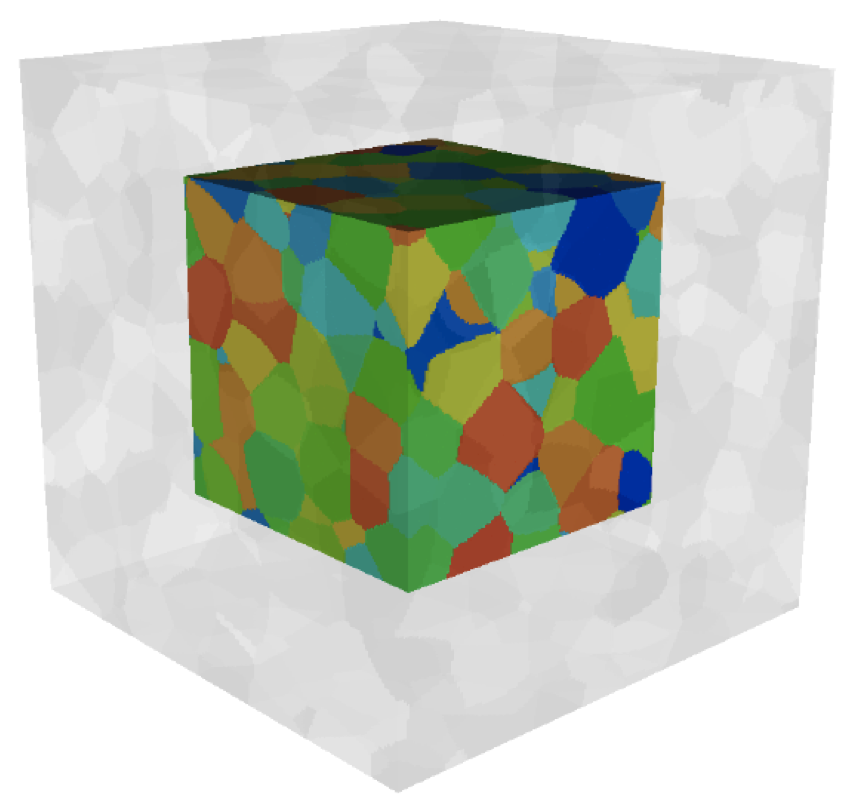
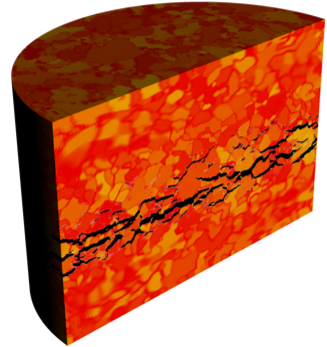
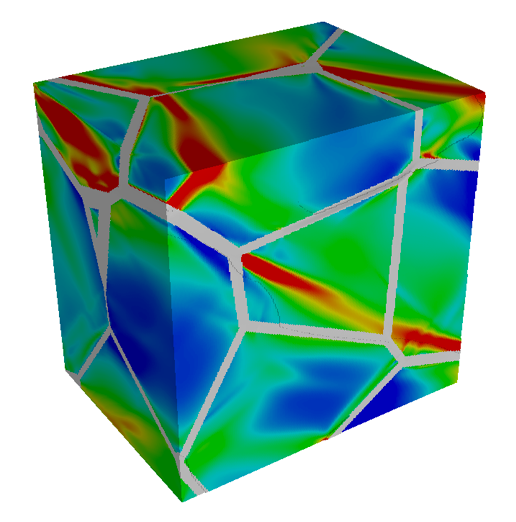
WelcomeWelcome to the Computational Mechanics of Materials Laboratory at Marquette University. Our overarching goal is to understand, predict and improve materials performance through advancements in materials modeling. Materials drive technology; however, improving modern structural materials is a formidable challenge involving sophisticated techniques, beyond the Edisonian (trail-and-error) approach. Our work strives to use computational modeling to understand the connection between materials microstructure and their properties, build tools to predict materials performance in environments that are difficult to access experimentally, and ultimately transfer this knowledge to materials and product designers. NewsANNOUNCEMENTAI/Machine Learning:Gaussian Processes and Bayesian Optimization for Hydrocode Simulations WHAT: Please join us for an AFRL Regional Network Midwest workshop on AI/Machine Learning: Gaussian Processes and Bayesian Optimization for Hydrocode Simulations. This workshop will cover the fundamentals of Gaussian process surrogate modeling and Bayesian optimization, along with applications to large-scale multiphysics simulations in hydrocodes (e.g., CTH, ALE3D, Zapotec, etc.). AI and machine learning approaches have become popular for "big data" problems. However, for complex multiphysics problems, both simulation and physical data are sparse. Multiphysics hydrocode simulations often involve a wealth of calibration parameters that must capture limited experimental data. Likewise, these simulations are computationally expensive, making trial-and-error parameter determination or optimal design impractical. Gaussian process regression, Bayesian optimization, and multi-fidelity predictions overcome these challenges and are covered in this workshop. This workshop is highly application focused. There will be numerous Python example problems, hands-on exercises, and opportunities to run and optimize hydrocode simulations. No access to a hydrocode is required; we will provide a 1D open-source hydrocode. Participants are encouraged to bring their own example problems. The second day of the workshop will focus on individual problems, applying the methods learned, and troubleshooting with experts. RegistrationFee / RSVP: There is no registration fee. Please RSVP to john.a.moore@marquette.edu by August 20, 2026. DateAugust 26–27, 2026 LocationDoolittle Institute ; Niceville, Florida The Doolittle Institute (DI) was established in 2012 as a 501(c)(3) nonprofit within the Defensewerx ecosystem. DI provides services under a Partnership Intermediary Agreement (PIA) to support the Air Force Research Laboratory (AFRL/RW) in developing and executing its technology transfer strategy. DI facilitates partnerships that drive technology transfer between the laboratory, businesses, and academia, with a particular emphasis on engaging small, nontraditional businesses. In addition, DI's STEM outreach programs help meet AFRL/RW's future workforce needs by inspiring today's students to become tomorrow's STEM professionals. Tentative AgendaDay 1 Morning SessionTheory of Gaussian processes (GP) and Bayesian optimization Python 1D GP and Bayesian optimization examples Combining experiments and simulations using multi-fidelity predictions Python examples of multi-fidelity prediction methods and applications for reducing overfitting with sparse experimental data Day 1 Afternoon SessionApproaches to multidimensional optimization using Gaussian processes and Bayesian optimization Comparison of GP with other machine learning, data-driven, and AI approaches Hands-on hydrocode optimization using a 1D open-source hydrocode Day 2 Morning SessionBest practices for Gaussian processes, Bayesian optimization, and multi-fidelity prediction: Design of experiments Selection of kernels and kernel hyperparameters Choice of acquisition functions Exploration of participant problems with expert troubleshooting Day 2 Afternoon SessionContinued exploration of participant problems with expert troubleshooting Breakout sessions and discussion Other NewsCheck out are recent work on X-ray tomography of damage dynamics in advanced materials using a laser wakefield accelerator Scientific Reports The computational mechanics of materials lab is working with industry to optimize Triply Periodic Minimal Surfaces (TPMS) for applications in outer space Read More Our team was recently awarded an AFRL Regional Network - Midwest Grant. See the News Release We've found that wire size effects the fatigue behavior of superelastic nitinol Materials Science and Engineering: A Our team has developed software for nonlocal modeling, see the writeup in Software Impacts Check out this new approach to modeling the statistical stread in fatigue life of polycrystals Fatigue & Fracture of Engineering Materials & Structures
|
|